
During the once-in-a-century pandemic event, the performance of extended-stay hotels peaked at 120% RevPAR Index vs. transient hotels within their comparable hotel class. Developers and investors then flocked to build extended-stay hotels, new extended-stay brands rolled out, and extended-stay properties became the path of least resistance for hotel financing. Since then, extended-stay hotels’ RevPAR Index has returned to historic levels, and length-of-stay patterns have slightly shortened. But new brands keep rolling out, the pace of new supply continues to accelerate, and extended-stay profit margins keep outperforming.
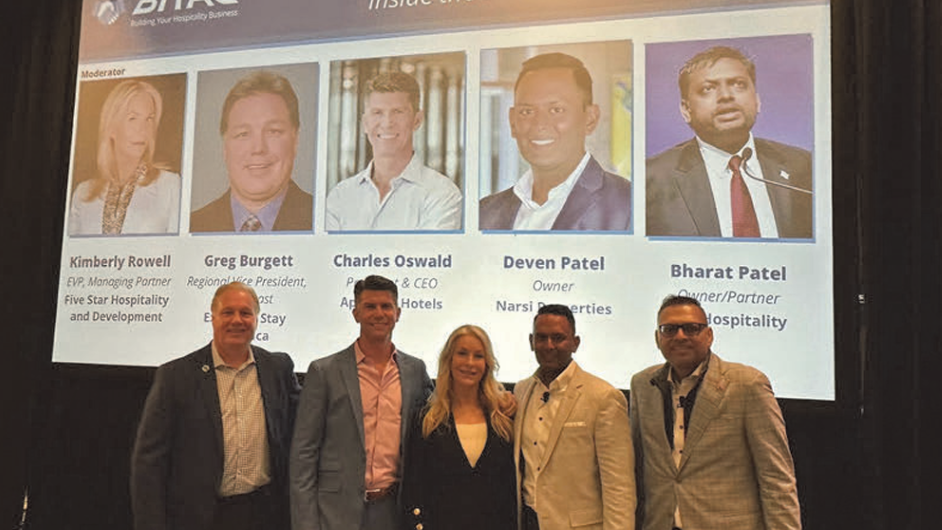
A recent BITAC panel sought to inform investors, developers, and suppliers on the latest trends. Here are a few excerpts from panelist Charles Oswald, CEO of Aperture Hotels.
Moderator: Kimberly Rowell, EVP, Managing Partner of Five Star Hospitality and Development
Q: How does the extended-stay segment perform vs. transient counterparts within their comparable classification?
A: Extended-stay properties outperform transient properties within their comparable hotel classification by a topline index of approximately 110%, and they yield substantially better profit margins and more stable demand patterns vs. their transient counterparts.
The extended-stay (i.e., seven-plus-night stay) segment is a $16.3B market. However, just $7.4B of that revenue is staying at purpose-built extended-stay hotels, while $8.9B remains at transient hotels. That’s a primary reason why 52% of today’s new hotel development is extended stay.
Risk mitigation: The second reason why extended-stay development is hot today is because labor risk and performance risk are lower. They also outperform by the highest margin during downturns and disasters.
However, while U.S. extended-stay demand and revenue are still growing, the extended-stay segment is presently experiencing unfavorable RevPAR percent change, as new supply is outpacing demand, resulting in modest occupancy, ADR, and RevPAR declines.
Q: What guest/consumer trends do you see affecting extended-stay hotel revenue?
A: Extended-stay segment performance peaked at a 120% index in 2020, during the once-in-a-century pandemic event. Developers and investors then rushed to build extended-stay hotels, new extended-stay brands rolled out, and financing became simpler. Since then, extended-stay hotels have returned to their historic RevPAR levels and are performing slightly lower than in 2019. Why?
- Pandemic-era stimulus checks temporarily stimulated leisure travel and residency among lower-income Americans.
- Customer preferences favor more experiential stays among upper-income American travelers, and they’re willing to pay for them. That’s why the luxury and upper-upscale tiers have been the only classifications to grow RevPAR over the last two years.
- Developers contemplating extended-stay hotels should incorporate low-cost ways to add services and experience. That’s what the guest wants today.
Q: What’s the ideal “length of stay” sweet spot for profitability and brand identity?
A: Generally speaking, longer stays are more profitable than short-term stays. That’s especially true for stay patterns under seven nights. However, when pricing by length of stay, do your math. For instance, if an extended-stay hotel cleans rooms on every fourth night, then a four-night stay is more efficient than a five-night stay, and an eight-night stay runs a higher profit margin than a nine-night stay at the same price. Why? Because an eight-night stay is cleaned twice (after the fourth night and the eighth night), while a nine-night stay gets cleaned three times, when you add the final cleaning after checkout.
Q: What role does technology play in improving the guest experience while managing operational costs?
A: Technology is generally about simplification and enabling more output for less input. In the case of extended-stay properties and apartment-style hotels, thoughtful technology can enable the provision of additional amenities that may not be feasible at a limited-service property. For example, robotic baristas/bartenders, kiosk check-in and ordering, scan-and-go market concepts, robot vacuums, and AI reservation agents can deliver additional services at a much lower cost than humans can today.

Q: From a developer’s standpoint, what makes an extended-stay project attractive from a return-on-investment perspective?
A: Extended-stay hotels have a clear advantage when it comes to markets where the RevPAR Index premium is greater than the construction cost premium.
Extended-stay hotels run 11 points higher occupancy than transient hotels within their comparable classification, but they index at 95% ARI, resulting in approximately 109% RGI vs. comparable transient hotels. By the way, that performance premium shrinks the further we go upscale.
Meanwhile, there is a roughly 13% development cost premium for the larger room format and kitchens compared to transient hotels under the same parent flag.
Q: What advice would you give to developers considering their first extended-stay project today?
A: The path to success is more simplified, but it’s not a slam dunk and does not work in every market. Make sure you’re not just delivering the hotel product that is easier to finance and open, but that you are actually building the product consumers want. Every market has its own unique thumbprint. Extended-stay patterns are much more prevalent in some markets than others. Seek a management company that can help you with market analysis and run reports to verify that the length-of-stay metrics are solid for the market where you are seeking to develop. A developer may find greater success by catering to today’s customer trends and building experiential design and efficient services/amenities into their extended-stay product.

